What Is a Roller Mill? Function, Applications, Advantages
A roller mill grinds mineral raw materials to a defined fineness in a continuous grinding process. It is used when uniform particle sizes with a low proportion of fine particles, reproducible process control, and efficient energy use are required.
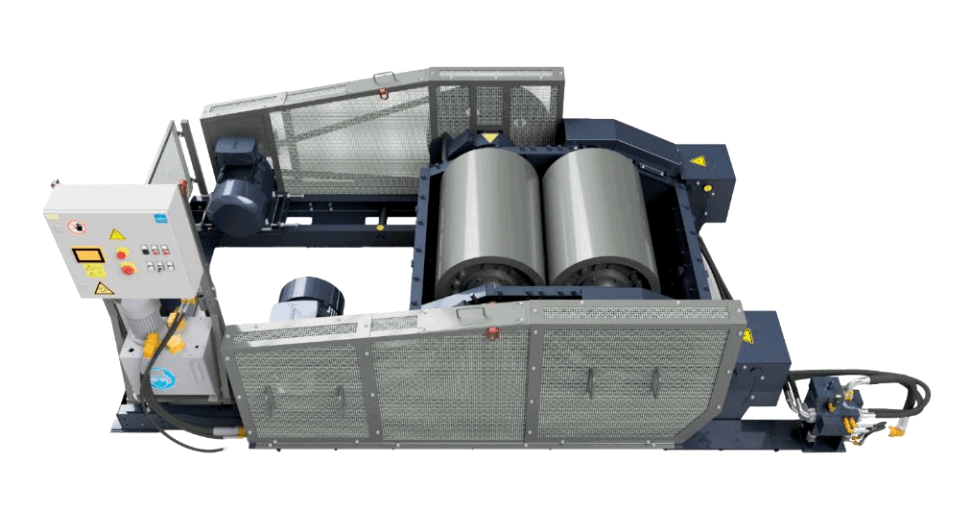
The Operating Principle of a Roller Mill in Raw Material Processing
Unlike roller crushers, a roller mill operates with smooth rollers. The material is captured between the rotating rollers and ground by pressure and shear forces.
The desired fineness can be precisely controlled by adjusting the roll gap. Modern roller mills enable uniform grinding while maintaining stable process control.
What are the main components of a roller mill?
At its core, a roller mill consists of smooth rollers, an adjustable roller gap, drive units, and a sturdy housing structure.
Roller mills feature hydraulic gap adjustment. Additionally, systems such as HAZtronic for process control and HAZoptic for optical monitoring of particle size can be integrated.
Where are roller mills used in processing?
Roller mills are used wherever material needs to be ground to a size of less than 1–12 mm with a low proportion of fine particles. Typical applications include raw material processing and mineral processing.
They are particularly suitable when:
- a defined particle size is required
- downstream processes require a uniform particle size
- energy efficiency plays a key role
Typical feed materials in material processing with roller mills
- limestone, dolomite, and mineral raw materials
- Slag and industrial byproducts
- Fine-grained recycled materials
Roller mill vs. roller crusher: What’s the difference?
While a roller crusher is primarily used for coarse to medium crushing, the roller mill is designed for finer grinding processes.
If a specific final particle size in the fine range needs to be achieved, the roller mill is the right choice. The roller crusher, on the other hand, is used when material must first be reduced to a particle size in the range of 12–300 mm.
To learn exactly how a roller crusher works, read here: What Is a Roller Crusher?
Overview of the Advantages and Limitations of a Roller Mill
A roller mill allows for precise control of the final particle size and operates energy-efficiently in many applications. At the same time, material properties and wear behavior must be taken into account.
Advantages: Fineness, efficiency, controllability
- Uniform and controllable particle sizes
- Efficient use of energy in the grinding process
- Good adaptability to different materials
- Stable process conditions during continuous operation
Limitations: Wear, material behavior
- Wear is possible with abrasive materials
- Moist or sticky materials can affect the process
- High demands on the tuning of process parameters
The HAZEMAG solution: HRM roller mill
For an overview of the roller mill solution for raw material processing, visit the product details page:
HRM Roller Mill
Roller mill for the energy-efficient processing of mineral raw materials, delivering consistent grinding and uniform particle size distribution.
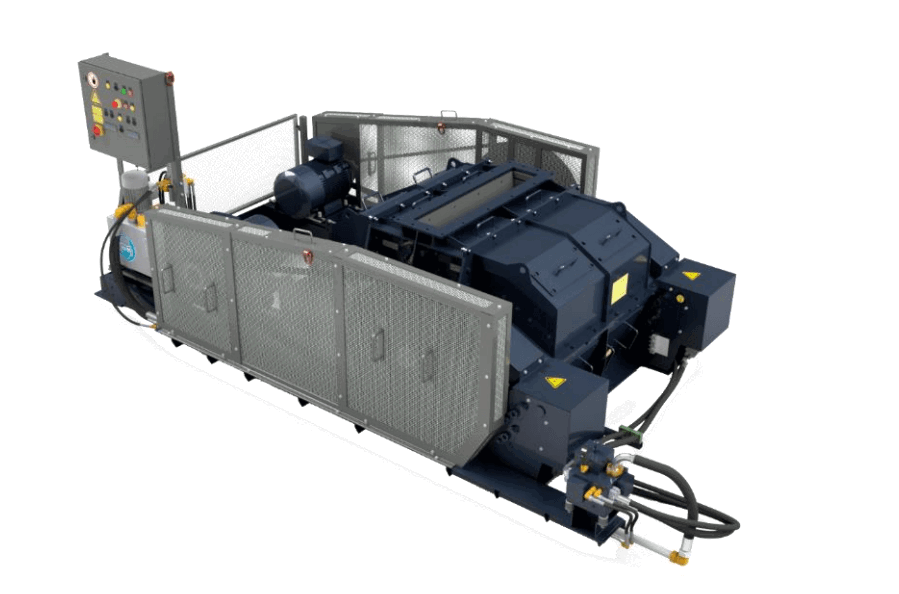
The HAZEMAG Solution: Roller Mills at a Glance
HAZEMAG offers roller mill solutions tailored to various raw material processing requirements. Want to know which roller mill is right for your material and target particle size?
FAQ: Roller Mills in Raw Material Processing
A roller mill is a grinding machine that reduces material between rotating smooth rollers using pressure and shear forces. The roller mill produces a defined fineness and the most uniform particle size distribution possible.
A roller mill feeds the material into a roller gap, where it is captured under pressure and ground. The fineness of the roller mill can be precisely adjusted by controlling the roller gap.
A roller mill is used when a fine, uniform particle size with a low proportion of fine particles is required and downstream processes demand a uniform particle size.
A roller mill is designed for fine grinding and specific fineness levels, whereas a roller crusher primarily reduces material to coarse to medium particle sizes. In the process chain, the roller mill is typically used in the fine processing stage, while the roller crusher is used in an upstream crushing stage.
Internal Links at a Glance
- Products → Our Products
- News → Our Blog
- Contact → Contact Page